You’ll transform your West County schoolyard into a nature-based learning environment by incorporating varied topography, native plantings, and loose natural materials that activate distinct cognitive pathways and improve executive function. Research shows outdoor classrooms deliver measurable improvements in problem-solving while costing 30-60% less than commercial equipment. Design clusters of 3-5 native plants per species for pollinator support, establish defined learning zones for cross-curricular integration, and implement zone-based supervision strategies that distinguish acceptable risks from genuine hazards. This thorough approach addresses design principles, budget considerations, safety standards, and maintenance protocols crucial for successful implementation.
Key Takeaways
- Natural outdoor classrooms improve student executive function, working memory, and creative problem-solving through attention restoration and varied sensory experiences.
- Cost-effective natural playgrounds cost 30-60% less than commercial equipment through community partnerships, volunteer labor, and local material sourcing.
- Native pollinator gardens serve as living laboratories for cross-curricular learning in mathematics, science, language arts, and social studies applications.
- Risk-balanced design supports adventurous play while maintaining ASTM F1487 compliance through regular safety audits and hazard management protocols.
- Zone-based supervision strategies and quarterly maintenance schedules ensure safe, functional outdoor learning environments throughout seasonal changes.
The Science Behind Nature-Based Learning Environments
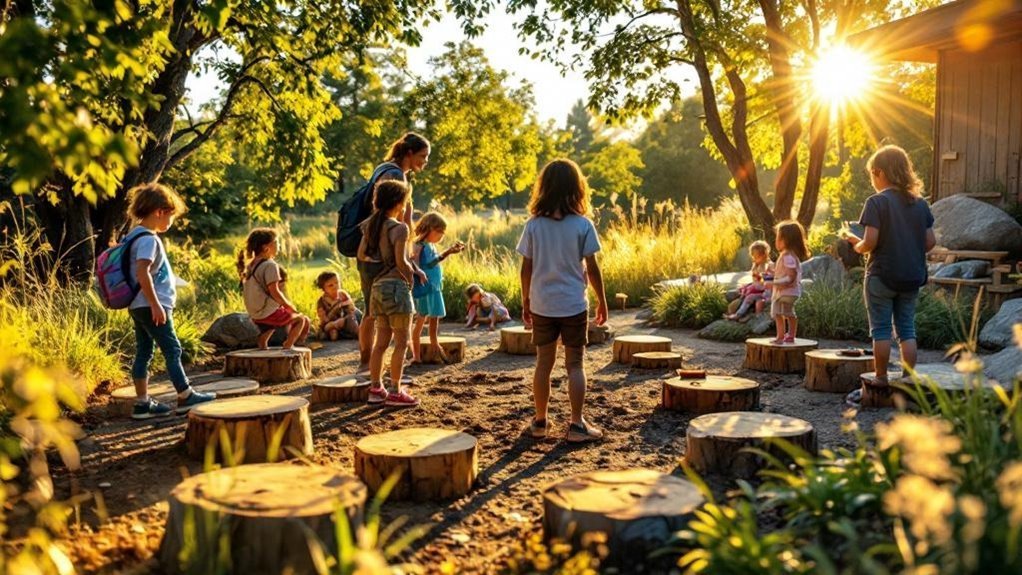
Research from environmental psychology and developmental neuroscience demonstrates that natural learning environments activate distinct cognitive pathways compared to traditional indoor classrooms. When you design outdoor learning spaces for West County schools, you’re leveraging nature benefits that directly support cognitive development. Students working in natural settings show improved executive function, enhanced working memory, and reduced cortical stress markers.
The mechanism involves attention restoration theory—natural environments engage “soft fascination,” allowing directed attention networks to recover while maintaining engagement. Your landscaping choices matter: biodiverse plantings, varied topography, and natural materials create complexity that stimulates neural development without overwhelming sensory processing. You’ll observe measurable improvements in problem-solving capacity, sustained attention spans, and creative thinking when students regularly access well-designed outdoor classrooms.
Design Elements That Transform Traditional Schoolyards
When converting asphalt-dominated schoolyards into learning environments, you’ll need to implement six core elements that research links to cognitive and physical development outcomes.
First, establish varied topography through berms and natural mounding. Second, integrate loose parts—movable materials like logs and stones—that encourage creative problem-solving. Third, install sensory pathways featuring diverse textures, from smooth river rocks to rough bark mulch.
Fourth, create defined learning zones with native plantings that support curriculum integration. Fifth, incorporate interactive installations such as musical walls, weather stations, and observation platforms. Sixth, guarantee accessible circulation routes connecting each zone.
You’ll maximize educational value by positioning these elements where they’re visible from classroom windows, enabling teachers to pre-plan outdoor lessons while maintaining sight lines for supervision.
Native Plants and Pollinator Habitats as Living Classrooms
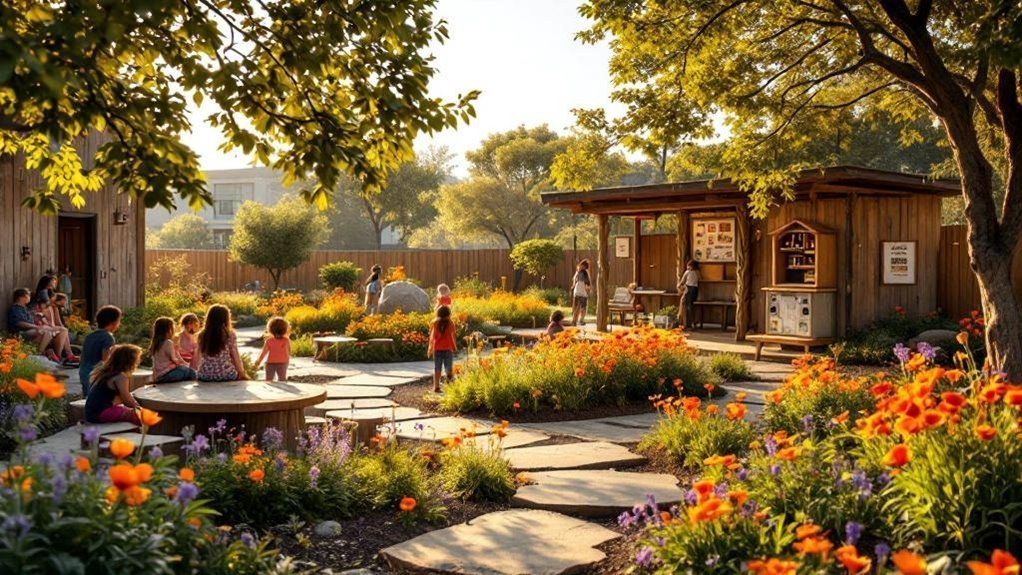
When you establish native plant and pollinator gardens in your schoolyard, you create field laboratories that support local ecosystems while meeting curriculum standards across science, mathematics, and environmental education. Your plant selection should prioritize regionally indigenous species that provide nectar, pollen, and host plant resources for target pollinator groups—bees, butterflies, moths, and hummingbirds—throughout the growing season. Strategic garden design incorporates observation zones, measurement stations, and documented seasonal changes that allow students to conduct authentic ecological research on plant-pollinator interactions.
Native Species Selection Guide
Selecting native plant species for educational environments requires systematic assessment of your site’s USDA hardiness zone, soil composition, hydrology patterns, and sun exposure metrics. You’ll maximize native flora benefits by matching species to specific microclimates within your schoolyard. Document existing conditions through soil tests and drainage observations before procurement.
| Plant Selection Criteria | Assessment Method |
|---|---|
| Soil pH and texture | Laboratory analysis |
| Moisture retention capacity | Percolation testing |
| Light availability (hours) | Shadow mapping |
| Student interaction zones | Safety radius planning |
Prioritize species that demonstrate ecological diversity while meeting educational objectives. Consider successional planting schedules that provide year-round learning opportunities. Select specimens with documented pollinator relationships, enabling students to witness mutualistic interactions firsthand. Verify all species through county extension resources.
Pollinator Garden Design Principles
Your selected native species become functional teaching tools when arranged according to pollinator-specific foraging behaviors and lifecycle requirements. Design clusters of 3-5 plants per species to maximize pollinator benefits through visual recognition and foraging efficiency. Position early, mid, and late-season bloomers in adjacent zones, ensuring continuous nectar availability from March through October. Integrate host plants for butterfly larvae near nectar sources, creating observable metamorphosis stations for student monitoring.
Layer plantings vertically: ground covers at 6-12 inches, perennials at 18-36 inches, and shrubs at 4-6 feet. This stratification improves garden aesthetics while accommodating diverse pollinator heights and nesting preferences. Install observation benches 4-6 feet from primary foraging areas, allowing students to document pollinator activity without disrupting natural behaviors. Label each species with botanical names, bloom periods, and associated pollinator species.
Hands-On Learning Activities
Transform your pollinator garden into a structured learning laboratory by implementing systematic observation protocols and data collection activities. Students can track pollinator visits using timed surveys, documenting species diversity and behavior patterns throughout seasons. Install weatherproof identification guides at observation stations to enable accurate species recognition during outdoor exploration sessions.
Design experiential learning modules around plant life cycles, requiring students to monitor native species from germination through seed production. Establish measurement stations where learners record bloom times, plant heights, and pollinator preferences using standardized data sheets. Create mapping exercises that challenge students to document spatial relationships between host plants and visiting species.
Integrate soil testing protocols to demonstrate nutrient cycling relationships. You’ll empower students to connect ecological theory with observable phenomena, encouraging environmental stewardship through direct engagement.
Budget-Friendly Implementation Strategies for Schools
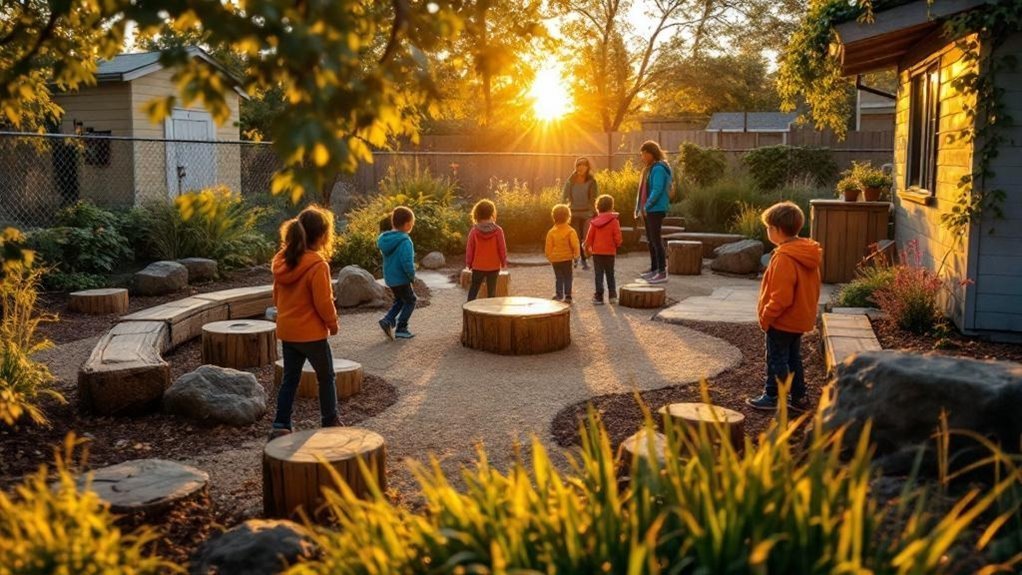
While elaborate commercial playground equipment can cost $50,000 to $150,000 per installation, you can create engaging natural play spaces for 30-60% less through strategic material sourcing and phased development.
Cost-Reduction Approaches:
- Partner with local arborists and horticulturists who’ll donate logs, stumps, and boulders rather than paying disposal fees
- Tap grant opportunities through state environmental education programs, community foundation funds, and corporate sustainability initiatives
- Organize community build days as fundraising ideas that simultaneously reduce labor costs and strengthen stakeholder investment
Phase implementation across fiscal years, starting with high-impact, low-cost elements like log balance beams and boulder clusters. Document student engagement metrics to support subsequent funding requests. Schools serving Title I populations qualify for additional federal grants specifically targeting outdoor learning infrastructure, maximizing resources for communities most needing enriched play environments.
Safety Considerations and Risk-Benefit Assessment
When designing natural playgrounds, you’ll need to balance developmental benefits against potential hazards through systematic risk-benefit assessment aligned with ASTM F1487 and CPSC guidelines. Your safety framework must establish clear protocols for regular inspections, surface testing, and hazard identification while distinguishing between acceptable developmental risks and preventable dangers. Effective implementation requires staff training on supervision strategies, documented maintenance schedules, and evidence-based policies that support risky play within controlled parameters.
Acceptable Risk in Play
Risk assessment in natural playgrounds requires a fundamental shift from eliminating all hazards to distinguishing between acceptable and unacceptable risks. You’ll need to adopt risk management that supports adventurous play while maintaining student safety. This approach recognizes that challenging experiences build resilience, decision-making skills, and physical competence in children.
Acceptable risks in your outdoor classroom include:
- Supervised tree climbing on stable branches with appropriate fall zones and impact-absorbing surfaces
- Natural balance beams and stepping stones that develop coordination while remaining age-appropriate
- Controlled interaction with natural elements like water features, sand, and variable terrain
Your focus should be identifying hazards that provide no learning value—broken equipment, toxic plants, or unsafe structural elements—while preserving challenges that promote growth, environmental stewardship, and confident exploration.
Safety Standards and Compliance
Before implementing any natural playground or outdoor classroom, you’ll need to guarantee compliance with established safety standards that govern design, installation, and maintenance. ASTM F1487 and CPSC guidelines establish baseline requirements, while regular safety audits identify hazards requiring immediate attention. You’ll conduct risk-benefit assessments documenting how play value justifies controlled exposure to challenge.
| Standard Type | Compliance Guidelines | Audit Frequency |
|---|---|---|
| Fall Surfaces | ASTM F1292 impact attenuation testing | Annual |
| Equipment Spacing | ASTM F1487 use zones verification | Quarterly |
| Material Integrity | Visual inspection protocols | Monthly |
| Accessibility | ADA compliance documentation | Semi-annual |
| Environmental Hazards | Site-specific risk assessment | Seasonal |
Documentation demonstrates your commitment to children’s safety while preserving authentic learning experiences through nature-based play environments.
Supervision and Maintenance Protocols
While natural playgrounds require less equipment maintenance than traditional structures, they demand more sophisticated supervision protocols and ecosystem management strategies. You’ll need to implement zone-based supervision strategies that account for varied terrain, natural sight-line obstructions, and seasonal environmental changes. Staff training must address risk assessment in dynamic outdoor environments where conditions shift with weather and growth cycles.
Essential Protocol Components:
- Quarterly hazard assessments documenting changes in vegetation density, erosion patterns, and wildlife activity
- Daily pre-use inspections focusing on trip hazards, standing water, and structural integrity of natural features
- Seasonal maintenance schedules synchronized with plant dormancy cycles and peak usage periods
Your documentation should track both scheduled interventions and responsive maintenance, creating accountability systems that protect students while preserving the environment’s educational and ecological value.
Cross-Curricular Learning Opportunities in Natural Spaces
Natural environments function as integrated teaching laboratories where mathematics, science, language arts, and social studies converge through direct observation and hands-on investigation. You’ll find students measuring tree circumferences for geometry lessons, documenting seasonal changes through nature journals, and conducting soil composition analyses. These interdisciplinary projects strengthen critical thinking while building environmental literacy.
| Subject Area | Activity Example | Measurable Outcome |
|---|---|---|
| Mathematics | Calculating garden plot areas and plant spacing ratios | Practical geometry application |
| Science | Recording weather patterns and ecological observations | Data collection proficiency |
| Language Arts | Writing field notes and creating botanical descriptions | Technical vocabulary development |
| Social Studies | Mapping campus habitats and studying indigenous plant use | Spatial reasoning skills |
Experiential learning in natural spaces produces documented gains in student engagement and content retention across all academic disciplines.
Community Involvement and Volunteer-Led Installation
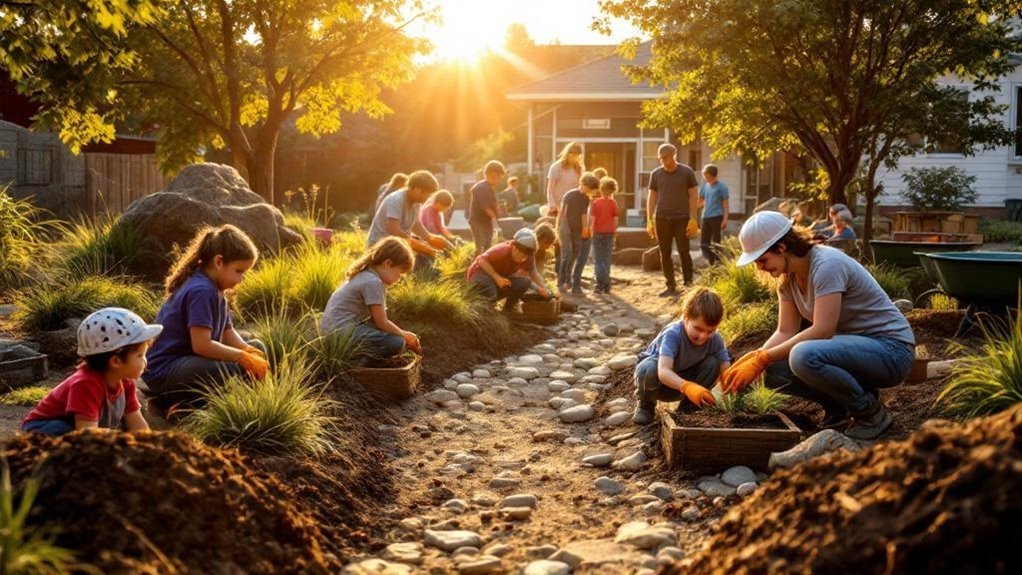
Successful natural playground construction relies heavily on coordinated volunteer networks that reduce installation costs by 40-60% while strengthening school-community bonds. You’ll need to establish clear project phases that match volunteers’ skill levels and availability. Community partnerships with local landscaping businesses, parent organizations, and skilled tradespeople provide crucial expertise and equipment access.
Effective volunteer engagement strategies include:
- Pre-installation workshops teaching proper boulder placement, edging techniques, and native plant installation methods
- Weekend build events organized into specific task stations with trained team leaders
- Post-installation maintenance schedules distributing ongoing care responsibilities across multiple community groups
You’ll maximize participation by creating detailed work plans, providing necessary tools, and scheduling builds around community calendars. Document volunteer contributions through photos and impact metrics, reinforcing their investment in students’ outdoor learning environments.
Maintenance and Seasonal Care of Outdoor Classrooms
Unlike traditional indoor facilities, outdoor classrooms require year-round maintenance protocols that address weathering, biological growth, and seasonal usage patterns. You’ll need to implement seasonal checklists that prioritize different tasks throughout the year. Spring maintenance focuses on mulch replenishment, drainage assessment, and planting bed preparation. Summer requires irrigation system monitoring and vegetation management to prevent overgrowth. Fall demands leaf removal, surface stabilization, and winterization procedures for water features. Winter maintenance schedules should include ice management, structural inspections, and equipment protection.
Document all observations using standardized forms that track degradation patterns and material performance. This data allows you to predict replacement cycles and budget accordingly. Assign specific maintenance responsibilities to staff members, parent volunteers, and professional contractors based on technical requirements and safety considerations.
Measurable Outcomes: Academic Performance and Student Wellbeing
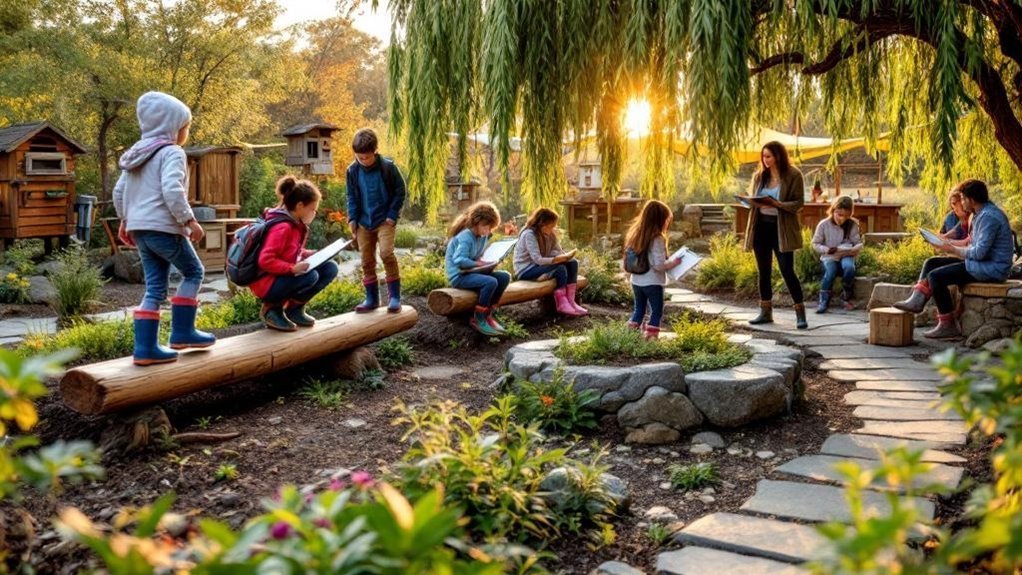
When you shift from design and maintenance protocols to impact assessment, you’ll need to establish baseline metrics before outdoor classroom implementation and track them consistently across multiple academic years. Document standardized test scores, attendance rates, and behavioral referrals to quantify academic engagement improvements. Partner with school counselors to monitor mental health indicators through validated screening tools and student self-reports.
Key Performance Indicators to Track:
- Comparative analysis of focus duration and task completion rates between outdoor and traditional classroom settings
- Quarterly assessments of student stress levels, anxiety markers, and social-emotional competency scores
- Longitudinal data on absenteeism patterns and academic achievement across all demographic groups
These measurable outcomes provide evidence-based justification for sustained investment in natural learning environments that serve your students’ comprehensive development.
Conclusion
You’ve seen the evidence: natural playgrounds aren’t just beautiful—they’re investment portfolios yielding returns in academic performance, physical health, and environmental literacy. Your site assessment data, native plant selections, and volunteer coordination strategies position your West County school to implement these outdoor classrooms cost-effectively. The research confirms measurable benefits across standardized test scores and behavioral metrics. Transform your underutilized schoolyard into a living laboratory where students don’t just learn about ecosystems—they become active participants in them.
