You’ll transform your Eureka garden into a resilient ecosystem by selecting native plants adapted to Missouri’s Ozark Border region. Purple Coneflower, Black-Eyed Susan, and Butterfly Milkweed attract specialized pollinators while establishing deep taproots that stabilize clay soils and reduce irrigation needs. Incorporate Little Bluestem and Switchgrass for erosion control, Wild Columbine for early-season nectar, and Spicebush for swallowtail butterflies. Aromatic Aster extends bloom periods through November. Each species contributes specific ecological functions that create self-sustaining environments requiring minimal maintenance once established.
Key Takeaways
- Purple Coneflower and Black-Eyed Susan attract over 40 native bee species while providing drought tolerance and extended blooms.
- Butterfly Milkweed serves as essential Monarch host plant with vibrant orange flowers and minimal irrigation needs once established.
- Little Bluestem stabilizes soil with deep roots, reduces stormwater runoff, and provides year-round wildlife habitat and cover.
- Eastern Redbud and Spicebush offer early-season nectar, nitrogen fixation, and critical support for native butterflies and birds.
- Aromatic Aster provides crucial fall blooms for late-season pollinators and thrives in Missouri’s clay-based soils.
Purple Coneflower (Echinacea Purpurea)
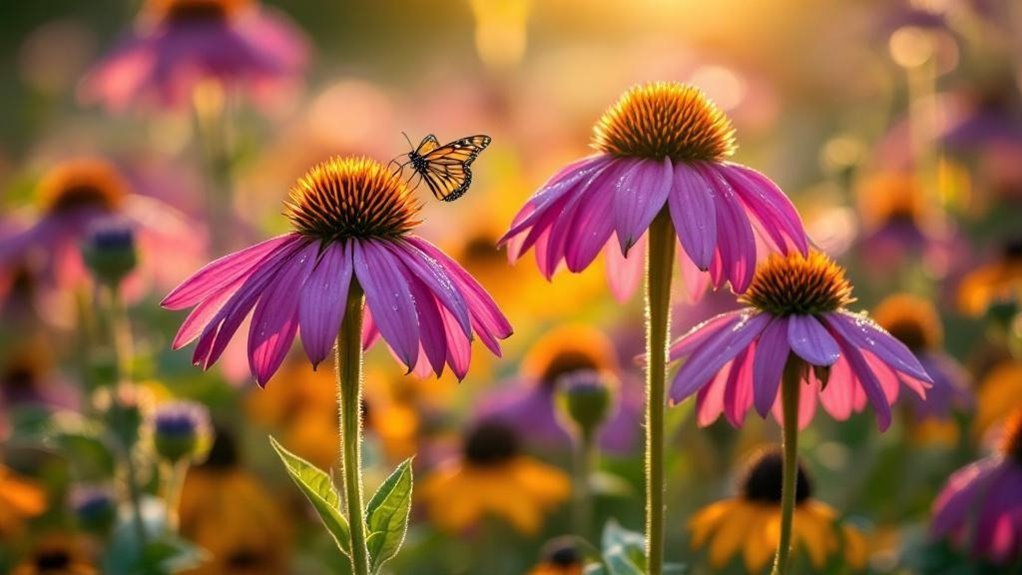
Purple Coneflower (*Echinacea purpurea*) thrives as a keystone pollinator species throughout Eureka’s native prairie remnants and restored meadow ecosystems. You’ll support critical pollinator populations by establishing this Missouri native, which attracts specialized native bees, butterflies, and goldfinches seeking its protein-rich seeds. Echinacea benefits extend beyond wildlife value—its deep taproot structure prevents soil erosion while accessing moisture during drought periods typical of eastern Missouri summers.
For successful Echinacea propagation, you can direct-sow seeds in fall or start cold-stratified seeds indoors eight weeks before spring planting. Space transplants 18-24 inches apart in full sun with well-drained soils. This perennial establishes robust root systems within two years, requiring minimal irrigation once mature—conserving water resources while providing reliable bloom periods from June through September for community pollinator gardens.
Black-Eyed Susan (Rudbeckia Hirta)
Black-eyed Susan (Rudbeckia hirta) thrives in Eureka’s temperate climate when you provide full sun exposure and well-drained soils with moderate moisture. You’ll support critical pollinator populations, as this species attracts native bees, butterflies, and beneficial insects while providing late-season seeds for goldfinches and other granivorous birds. Your maintenance requirements remain minimal once established, though you’ll need to monitor seedling recruitment and adjust deadheading practices based on whether you’re prioritizing extended bloom periods or wildlife food resources.
Growing Conditions and Requirements
Light exposure markedly influences biomass production and flowering intensity. Position plants in full sun locations receiving six to eight hours of direct solar radiation daily. Partial shade tolerance exists, particularly in southern exposures, though you’ll observe reduced floral abundance and stem elongation. Once established, drought tolerance emerges through deep taproot development, making supplemental irrigation unnecessary after the first growing season—a critical advantage for water-conscious community gardens serving Eureka’s conservation goals.
Wildlife and Pollinator Benefits
As nectar production peaks during late summer when alternative food sources dwindle, Black-Eyed Susan (Rudbeckia hirta) serves as a crucial nutritional reservoir for Eureka’s pollinator populations. You’ll support over 40 native bee species, including specialized oligolectic bees dependent on Rudbeckia pollen for larval development. Migrating monarch butterflies utilize these flowers as vital refueling stations during their southward journey through Missouri’s tallgrass prairie corridors.
The plant’s composite flower structure provides accessible landing platforms for both short-tongued and long-tongued pollinators, maximizing your garden’s functional diversity. American goldfinches consume the seed heads throughout winter, while caterpillars of the Silvery Checkerspot butterfly rely on foliage for host-plant survival. By establishing Black-Eyed Susans, you’re restoring native habitats and strengthening ecosystem health through trophic-level support that extends beyond primary pollination services.
Maintenance and Seasonal Care
Though Black-Eyed Susan exhibits exceptional drought tolerance once established, you’ll need to provide consistent moisture during its first growing season to promote robust taproot development extending 18-24 inches into Eureka’s clay-loam soils. After establishment, minimal intervention maximizes your garden’s ecosystem services:
- Spring emergence: Apply 2-inch compost layer as soil amendment to improve moisture retention in Missouri’s variable precipitation patterns
- Mid-summer: Deadhead spent blooms to extend flowering period through September, benefiting late-season pollinators
- Fall management: Delay seasonal pruning until late winter, allowing seed heads to provide vital finch sustenance during resource-scarce months
- Winter preparation: Leave standing stems intact—hollow stalks offer crucial overwintering habitat for native cavity-nesting bees
This maintenance approach supports biodiversity while reducing your labor investment.
Wild Columbine (Aquilegia Canadensis)
Wild Columbine (*Aquilegia canadensis*) thrives in the mesic to dry-mesic woodlands and rocky slopes characteristic of Eureka’s native ecosystems, occupying ecological niches from shade-dappled forest edges to limestone outcroppings. Understanding wild columbine habitat requirements allows you to position this perennial strategically where its nodding red-and-yellow flowers attract ruby-throated hummingbirds and native long-tongued bees during April through June bloom periods.
You’ll find wild columbine propagation succeeds through direct autumn seeding or careful root division of established plants. Seeds require cold stratification for germination, making fall sowing ideal. This self-seeding transitory establishes robust taproots that anchor plants in shallow, well-drained soils where few ornamentals persist. By incorporating Wild Columbine into restoration projects or residential environments, you’re providing critical early-season nectar resources while supporting pollinator networks vital to community ecological health.
Little Bluestem (Schizachyrium Scoparium)
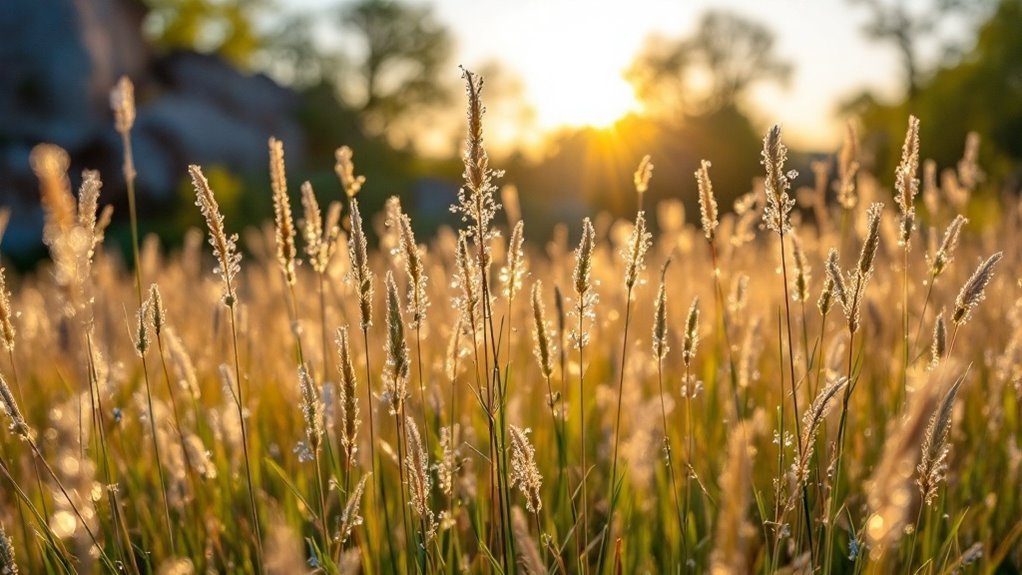
Little Bluestem (*Schizachyrium scoparium*) dominates Eureka’s tallgrass prairie remnants and upland savanna communities, where its warm-season growth pattern and drought tolerance make it fundamental to regional grassland architecture. You’ll maximize native grass benefits by establishing this bunchgrass on slopes and disturbed sites requiring soil erosion control. Its fibrous root system penetrates 6-8 feet deep, stabilizing substrates while creating wildlife habitat.
Ecological functions include:
- Providing larval host plants for skipper butterflies (*Hesperiidae*)
- Offering persistent winter cover for ground-nesting birds
- Establishing mycorrhizal networks that support companion forbs
- Reducing stormwater runoff through improved infiltration rates
You’ll observe bronze-copper autumn coloration persisting through winter, contributing structural interest while supporting overwintering invertebrates crucial to food webs serving native songbird populations.
Butterfly Milkweed (Asclepias Tuberosa)
Butterfly Milkweed (*Asclepias tuberosa*) produces clusters of vibrant orange flowers from June through August, attracting numerous pollinators to Eureka’s prairie ecosystems. This perennial serves as the obligate host plant for Monarch butterfly (*Danaus plexippus*) larvae, making it critical for the species’ declining Midwestern populations. Once established in well-drained soils, the plant’s deep taproot facilitates survival through extended drought periods typical of Missouri’s tallgrass prairie remnants.
Vibrant Orange Summer Blooms
Among North America’s most ecologically significant native perennials, Asclepias tuberosa thrives in Eureka’s well-drained soils and full-sun exposures from June through August. Its vibrant orange petals distinguish it from other summer bloom varieties, creating striking visual impact while serving critical ecological functions.
You’ll support specialized pollinators by establishing this drought-tolerant species:
- Monarch butterflies rely exclusively on Asclepias species for larval development
- Native bees access nectar through the plant’s distinctive umbel formations
- Hummingbirds occasionally visit these conspicuous blooms during migration periods
- Beneficial insects utilize the foliage for shelter and reproduction
This taproot species tolerates Missouri’s clay-loam substrates once established, requiring minimal supplemental irrigation. Plant 18-24 inches apart in prairie restoration projects or pollinator gardens to maximize habitat value while maintaining aesthetic appeal throughout the growing season.
Essential Monarch Butterfly Host
Asclepias tuberosa functions as the primary larval host plant for Danaus plexippus (monarch butterfly) populations throughout Eureka’s geographic region. You’ll support crucial monarch migration patterns by establishing this species in your environment, as caterpillars can’t survive without consuming milkweed foliage. Missouri’s position along the Central Flyway makes your garden a crucial refueling station for monarchs traveling between Mexican overwintering sites and Canadian breeding grounds.
This drought-tolerant perennial thrives in well-drained soils and full sun exposure typical of Eureka’s conditions. You’ll provide important host plants that directly combat declining monarch populations—a 90% decrease over two decades. Plant multiple specimens to accommodate heavy caterpillar feeding. Unlike common milkweed, butterfly milkweed won’t spread aggressively, allowing controlled placement within pollinator corridors you’re creating for community benefit.
Drought-Tolerant Prairie Native
Your garden’s native prairie ecosystems evolved under moisture-limited conditions, making butterfly milkweed exceptionally adapted to Eureka’s periodic drought cycles and low-precipitation seasons. This Asclepias species employs sophisticated drought resilience strategies through its deep taproot system, accessing subsurface water reserves unavailable to shallow-rooted competitors.
Prairie ecosystem benefits you’ll provide include:
- Xeric habitat creation supporting specialist pollinators during water-stressed periods
- Soil stabilization through extensive root networks preventing erosion on slopes
- Reduced municipal water consumption in community environments and residential plantings
- Improved biodiversity corridors connecting fragmented tallgrass prairie remnants
You’ll observe this milkweed thriving in full sun exposure with minimal supplemental irrigation once established, demonstrating remarkable physiological adaptations including reduced leaf surface area and CAM-like water conservation mechanisms during extreme heat events.
Eastern Redbud (Cercis Canadensis)
The Eastern Redbud (*Cercis canadensis*) serves as a critical early-season nectar source for native pollinators throughout the Ozark Highland and Mississippi Alluvial Plain ecoregions surrounding Eureka. You’ll support Mason bees, mining bees, and early-emerging butterflies when you establish this understory tree in your environment. Eastern redbud symbolism resonates deeply with community-oriented gardeners—its heart-shaped leaves represent compassion while its abundant blooms demonstrate generosity to wildlife.
For successful eastern redbud propagation, you’ll need to scarify seeds mechanically or cold-stratify them for 60-90 days. Plant specimens in well-drained, limestone-derived soils with partial shade. This tree tolerates Missouri’s clay soils exceptionally well while providing nitrogen fixation through its leguminous root system. You’re creating vital habitat when you incorporate this 20-30 foot native into woodland edges or naturalized areas.
Spicebush (Lindera Benzoin)
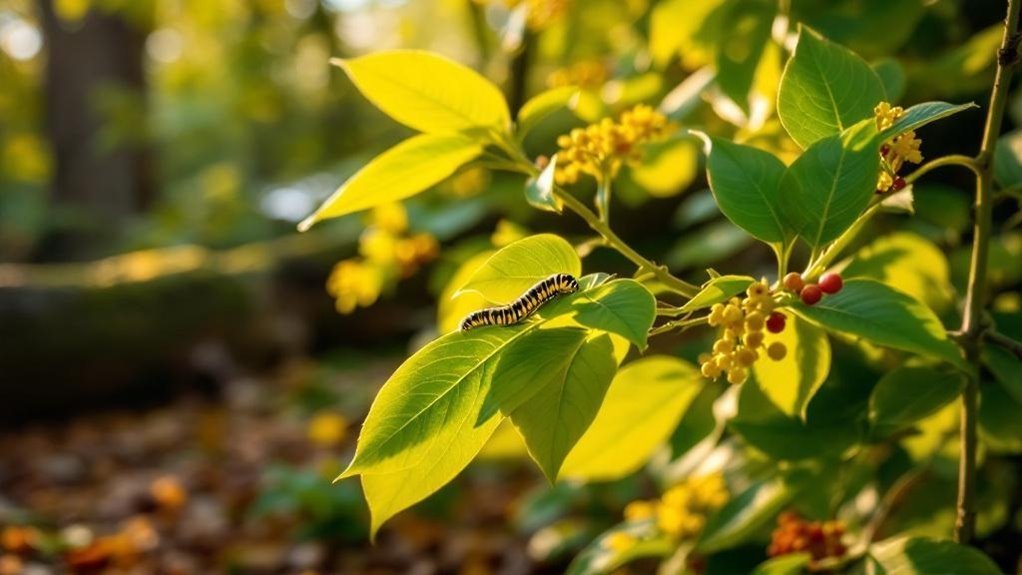
Thriving in Missouri’s moist woodland understories, spicebush (*Lindera benzoin*) functions as the obligate host plant for spicebush swallowtail butterflies (*Papilio troilus*) while providing critical lipid-rich berries for migrating thrushes and vireos throughout the Eureka region. You’ll appreciate its aromatic qualities—crushed leaves and stems release a pleasant fragrance. For effective environment design in shaded areas, consider these cultivation parameters:
- Plant in mesic to hydric soils with pH 5.5-7.0
- Position in partial to full shade beneath canopy trees
- Maintain 6-12 feet spacing for mature specimens
- Mulch with leaf litter to replicate forest floor conditions
Its dioecious nature requires both male and female specimens for fruit production. You’re supporting vital ecosystem services by establishing spicebush colonies that sustain local pollinator populations and migratory bird species.
Wild Geranium (Geranium Maculatum)
Wild Geranium (*Geranium maculatum*) produces five-petaled pink to lavender flowers from April through June, providing critical nectar resources during the spring pollinator emergence period. This herbaceous perennial thrives in partial to full shade conditions, requiring mesic woodland soils with pH levels between 5.5 and 7.0 for ideal growth in Eureka’s temperate climate. Native bees, including *Andrena* and *Lasioglossum* species, demonstrate strong foraging preference for Wild Geranium’s pollen and nectar, establishing it as a foundational component in understory pollinator habitat restoration.
Pink Spring Blooms
Consider these ecological benefits when establishing *G. maculatum*:
- Supports native pollinators including early-season bees and syrphid flies
- Tolerates black walnut allelopathy in established forest communities
- Self-seeds moderately without becoming invasive
- Pairs with *Phlox divaricata* and *Mertensia virginica* for vibrant color combinations
You’ll observe palmately-lobed foliage persisting through summer before senescing. This geophyte requires minimal maintenance once established in appropriate mesic to dry-mesic conditions, serving woodland garden restoration efforts throughout the Meramec River watershed.
Shade Tolerance Requirements
Although *Geranium maculatum* demonstrates remarkable adaptability across light gradients, it performs at its best under dappled canopy conditions that mimic its native woodland habitat throughout the Ozark Border region. You’ll find this species thrives in partial to full shade environments, making it invaluable for challenging understory plantings where other shade loving species struggle. The plant tolerates morning sun exposure particularly well, but afternoon shade becomes crucial during Missouri’s intense summer months. You should note that light requirements directly correlate with soil moisture availability—plants receiving more sunlight demand consistently moist substrates to prevent stress and maintain vigorous growth. When you establish Wild Geranium beneath oak-hickory canopies or along north-facing slopes, you’re creating ideal conditions that support both the plant’s ecological requirements and your community’s native biodiversity goals.
Attracts Pollinators Naturally
This geranium supports native biodiversity through:
- Early-season nectar provision when alternative floral resources remain limited
- Pollen protein content averaging 18-22%, sustaining larval bee development
- Accessible flower morphology accommodating short-tongued Halictidae species
- Extended bloom duration spanning 6-8 weeks under ideal moisture conditions
You’re creating functional habitat corridors when you integrate wild geranium into woodland edges and partial shade zones. *G. maculatum* establishes self-sustaining colonies through rhizomatous spread, requiring minimal intervention while maximizing pollinator provisioning throughout spring phenological windows.
Switchgrass (Panicum Virgatum)
Panicum virgatum stands as a warm-season bunchgrass that dominates tallgrass prairie ecosystems throughout Eureka’s biogeographic region. You’ll find switchgrass benefits extend beyond ornamental value—this species provides critical wildlife habitat, erosion control, and carbon sequestration in degraded environments. Native switchgrass varieties like ‘Kanlow’ and ‘Cave-in-Rock’ exhibit distinct morphological adaptations suited to Missouri’s clay-loam soils and seasonal precipitation patterns. You’re establishing vertical structure that supports grassland-dependent songbirds while creating protective cover for small mammals. This C4 photosynthetic grass tolerates drought conditions once established, making it invaluable for restoration projects serving communities vulnerable to climate variability. Plant switchgrass in full sun where its deep fibrous root system—extending 6-10 feet—stabilizes soil and filters stormwater runoff.
Aromatic Aster (Symphyotrichum Oblongifolium)
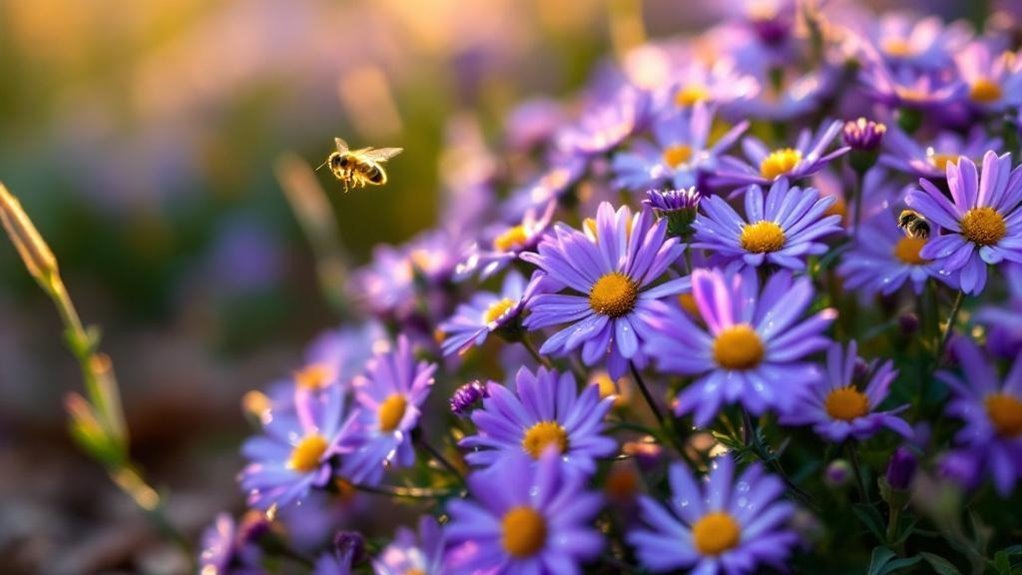
When late-season pollinators face dwindling nectar sources across Eureka’s terrain, Symphyotrichum oblongifolium emerges as a critical fall-blooming resource that sustains monarch butterflies, native bees, and migrating insects through October frosts. This drought-tolerant perennial thrives in Missouri’s clay-based soils, producing vibrant purple ray flowers from September through November.
Planting tips for establishing aromatic aster colonies:
- Position specimens in full sun locations with well-draining substrates
- Space plants 18-24 inches apart to accommodate mature 2-3 foot spreads
- Implement spring division every three years to maintain vigor
- Reduce irrigation once root systems establish (typically 8-12 weeks)
The aromatic benefits extend beyond nectar provision—crushed foliage releases volatile compounds that deter herbivores while attracting specialized pollinators. You’ll support ecosystem resilience by incorporating this species into pollinator corridors and rain gardens.
Conclusion
You’ll cultivate a living tapestry of Missouri’s botanical heritage when you integrate these native species into your Eureka scenery. These selections aren’t merely ornamental—they’re foundational components of local ecological networks, supporting pollinator populations, stabilizing substrates through fibrous root systems, and maintaining regional biodiversity. By selecting regionally-adapted taxa, you’re reducing irrigation demands, eliminating chemical inputs, and creating resilient plant communities that’ll thrive within Missouri’s temperate continental climate while supporting endemic fauna throughout successive phenological stages.

Leave a Reply